From evidence to architecture intelligence
ArkDock is a portable Architecture Intelligence Workbench. It connects governed evidence, architectural understanding, and implementation context without forcing those concerns into one monolithic product.
Codes and ALManac remain independent products. ArkDock is the wider portable workbench that shows how they fit together with adapters, agents, and delivery tools.
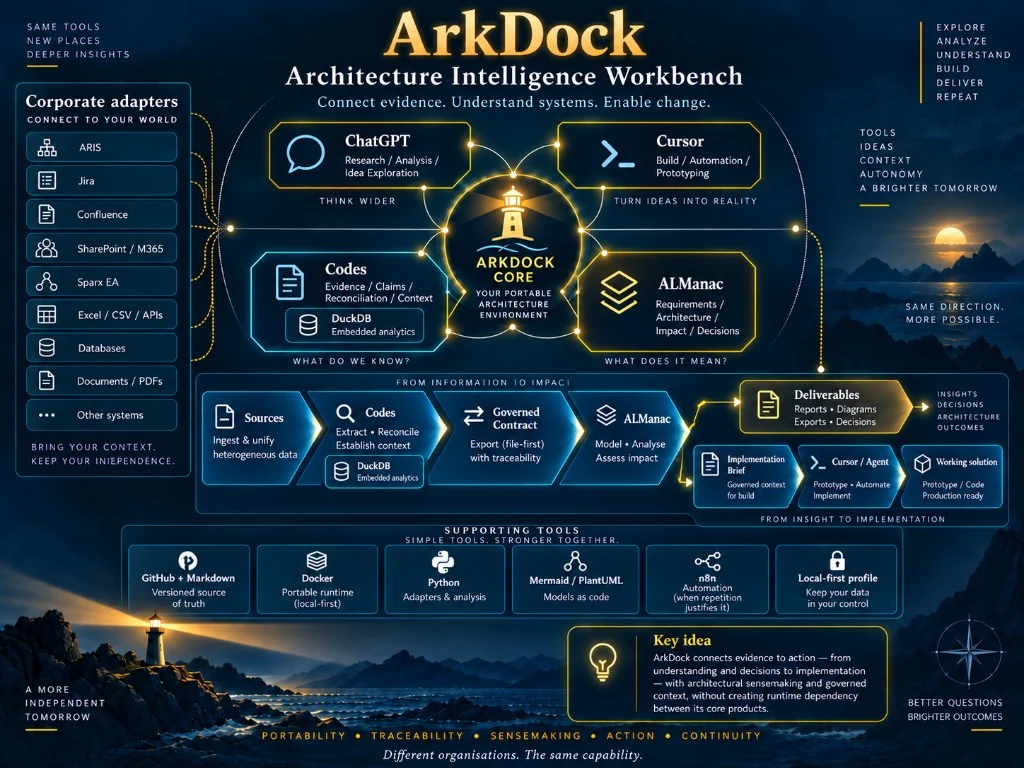
Two different questions
| Product | Guiding question | Focus |
|---|---|---|
| Codes | What do we know? | Evidence, claims, reconciliation, provenance, governed domain context |
| ALManac | What does it mean? | Requirements, architecture, impact, decisions, implementation context |
Codes may use DuckDB for embedded analytics. That is a Codes implementation detail, not the integration mechanism between Codes and ALManac.
Governed contract, not hidden coupling
The primary flow is:
- Sources — ingest and unify heterogeneous inputs.
- Codes — extract, reconcile, and establish governed context.
- Governed contract — export file-first with traceability.
- ALManac — model, analyse, and assess impact.
- Deliverables — reports, diagrams, exports, and decisions.
Integration stays governed and file-first. There is no silent approval path, no shared accidental database, and no requirement that ALManac depend on Codes at runtime. ALManac remains fully usable without Codes, GitHub, or an integration API. Foreign identifiers arrive as references or import proposals that still need human review on the ALManac side.
This page describes portable product relationships. It does not expose employer systems, internal programme data, or future product promises.
From understanding to action
Architectural outcomes in ALManac can feed an Implementation Brief: governed context for build. Agents and editors such as Cursor then help prototype, automate, or implement. Agents are tools, not architectural authorities. Approval, mapping, glossary, and publication decisions remain human-governed.
Portable by design
Corporate adapters bring organisational context in without locking the workbench to one platform. Typical sources include ARIS, Jira, Confluence, SharePoint / M365, Sparx EA, Excel / CSV / APIs, databases, and documents / PDFs. Supporting pieces can include GitHub and Markdown for versioned artefacts, Python for adapters and analysis, Mermaid / PlantUML for models as code, Docker where a packaged runtime is useful, and n8n only when repetition justifies automation. The local-first profile keeps data under operator control.
ALManac remains ALManac
ArkDock does not replace, rename, or absorb ALManac. ALManac keeps its independent product identity as the institutional continuity renderer for requirements, architecture, impact, and delivery-ready understanding.
Continue exploring
- Getting Started — concepts, workflow, and governed context between tools.
- Why ALManac Exists — origin story and design philosophy.
- Open the public demo — read-only Profile Navigator demo.
- View the research field. — LUX143 ecosystem orientation.