New Here?
Most systems do not fail in code. They fail much earlier, when the original intent becomes fragmented across meetings, handoffs, tickets, diagrams, and delivery layers.
What began as a clear business need slowly transforms into disconnected requirements, processes, and technical implementation. Eventually the system still works, but no longer does what people originally meant.
Think of it as a lighthouse
A lighthouse does not steer ships. It makes the environment readable, so people can navigate their own course while seeing where the hazards are.
ALManac works the same way. It does not tell your organization what to do or how to change. It makes organizational thinking visible, so delivery leaders can ask:
Is what we are building still aligned with why we started?
The problem it solves
In complex transformation programs, intent is constantly at risk:
- Strategy becomes requirements, and something is lost.
- Requirements become processes, and more is lost.
- Processes become technical design, and the original logic may become unrecognizable.
This is not a people problem. It is a structural one. Most tools are designed to hold information, not the thread of intent across translations.
What ALManac is
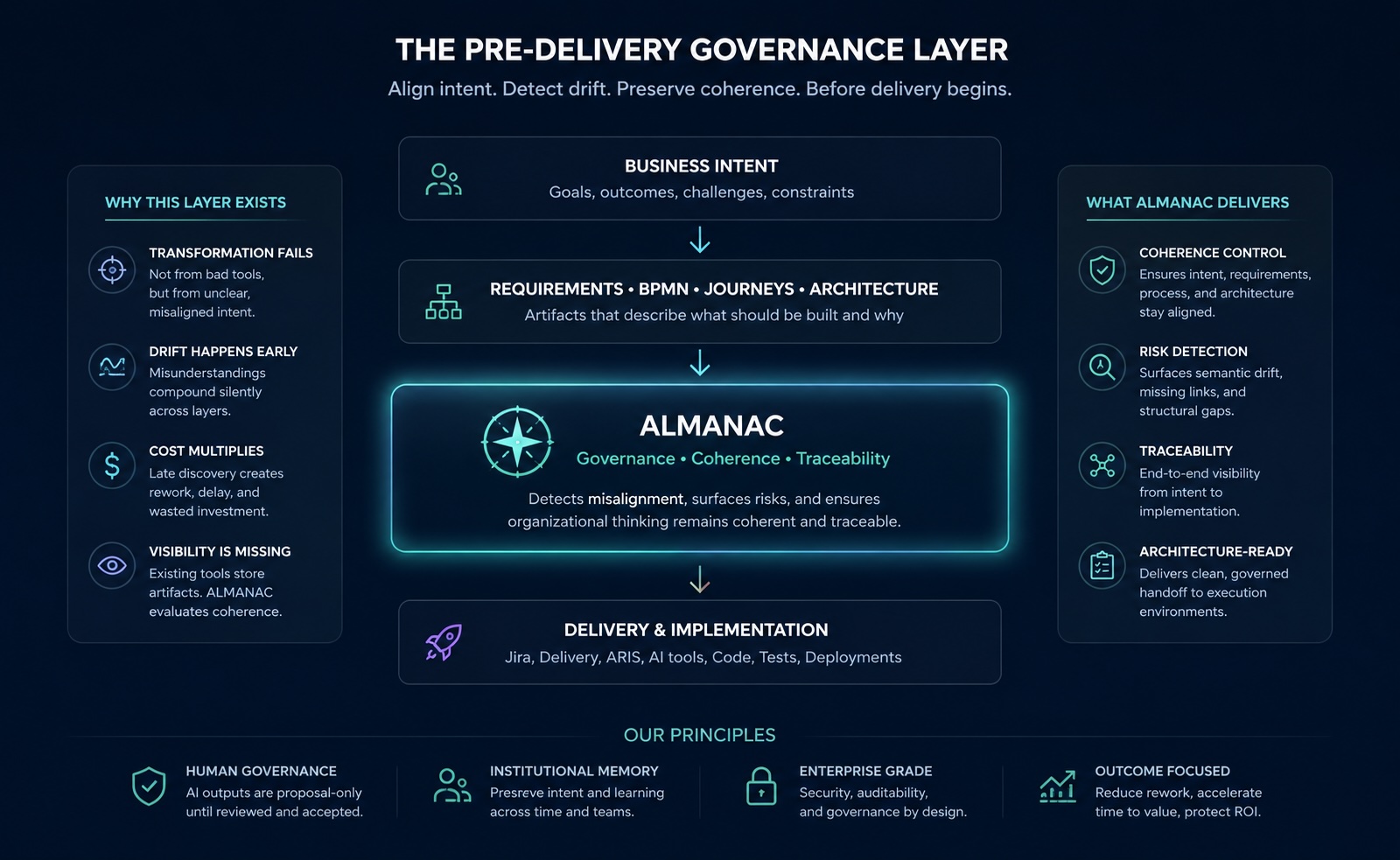
ALManac is a structural quality gate and institutional continuity renderer before delivery begins. It covers the work between business intent and downstream execution:
- structuring requirements from goals through acceptance criteria
- connecting requirements to process, role, data, and architecture context
- validating coherence before handoff
- preparing architecture-ready exports for downstream systems
It is not a sprint tool, defect tracker, code repository, or backlog manager.
What ALManac is not
ALManac is not an autonomous decision-maker, Jira replacement, or generic chatbot. It keeps evidence, meaning, and traceability readable so responsible people can make better governed decisions.
The wider research field and Guiding AI meaning are maintained outside this renderer.
See it in action
The public demo is a read-only Profile Navigator project. It is intentionally not the microsite homepage, because visitors should first understand what they are looking at.