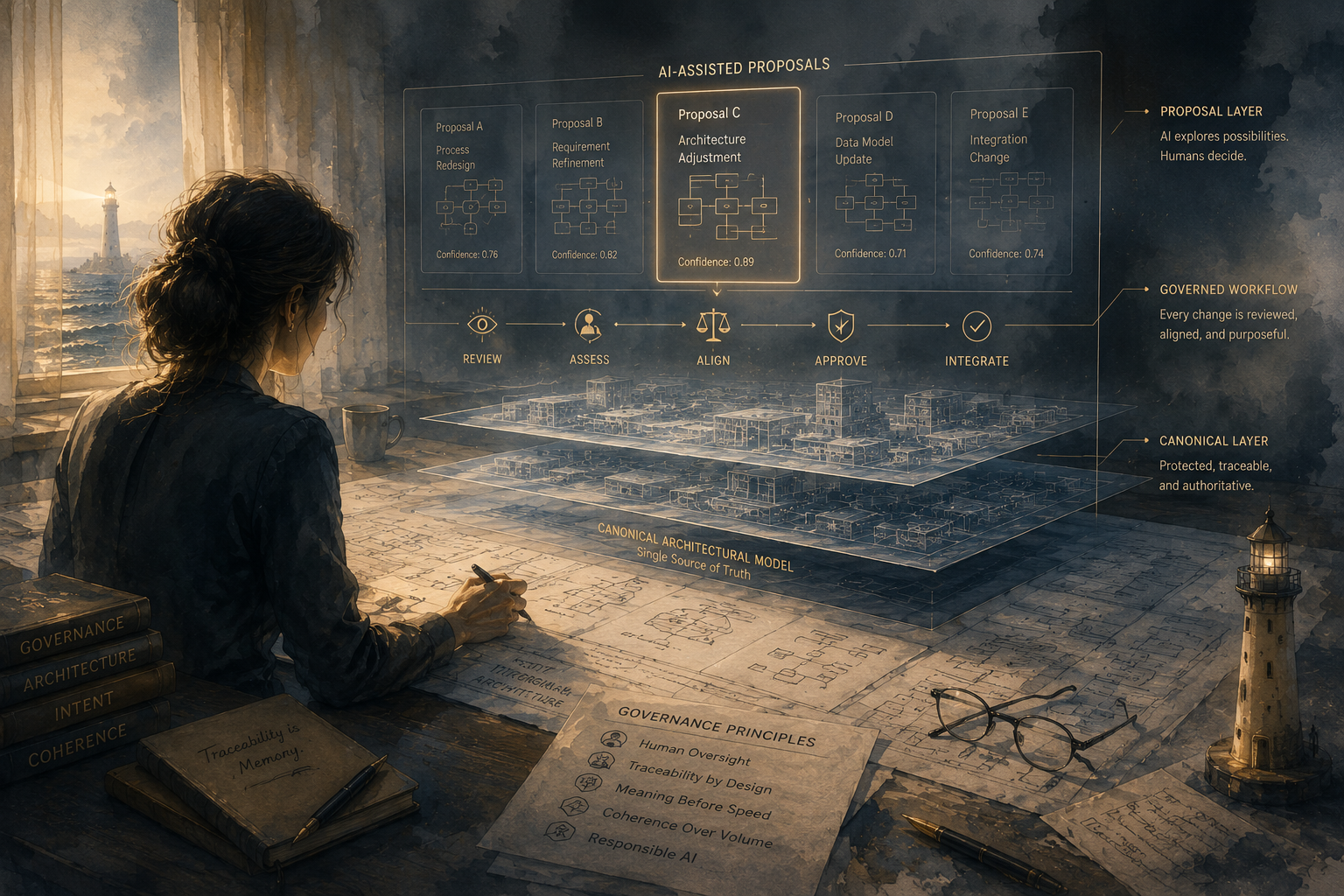
ALManac Prehistory
ALManac did not emerge as a theoretical exercise. It grew from years spent inside systems that continued to function while becoming harder and harder to understand.
How unreadable systems became an orientation problem
At first the problem looked technical: legacy systems, undocumented logic, disconnected requirements, hundreds of documents, thousands of rules, and contradictory exceptions.
After enough years inside these environments, another realization emerged:
Unreadability is not only a technical problem. It is an orientation problem.
From diagrams to narratives
Some systems become too large for diagrams. Too many edge cases, too many historical layers, too many exceptions that exist simply because they always have.
In those environments, scenarios become chapters and exceptions become plot twists. Architecture starts to behave less like a diagram and more like a story that must be reconstructed carefully.
That is where Narrative Architecture first appeared: not as theory, but as survival.
Why this matters for ALManac
Complex systems rarely collapse dramatically. Most of the time they keep operating while the original meaning fades.
ALManac responds to that pattern by making intent, traceability, and coherence visible before delivery locks the drift into reality.