Why ALManac Exists
This is the origin story and design philosophy behind ALManac: why it was built, what problem it responds to, and the principles that shape how it behaves.
Where it came from
ALManac was built inside real institutional transformation programs, including European public-sector environments where the stakes of getting coherence wrong were measurable in years and millions.
Talented people, clear strategies, good intentions, and yet something was repeatedly lost between the boardroom and delivery team: not the data, but the meaning behind the data.
The problem was never the tools. The tools were full of information. The problem was that none of them were designed to hold the thread of why.
The belief at its center
There is a moment in every complex transformation program when the people doing the work lose sight of the reason for it. Not because they stop caring, but because the systems around them were not built to keep it visible.
In complex systems, the light should remain human.
The name
ALManac stands for Architectural Logic and Meaning Analysis.
- Architectural: concerned with system structure, not surface features.
- Logic: the reasoning behind decisions.
- Meaning: the semantic layer that connects requirements to purpose.
- Analysis: a continuous reading of coherence.
The spelling echoes a nautical almanac: a navigational reference used to orient against fixed points when everything else is moving.
The lighthouse principle
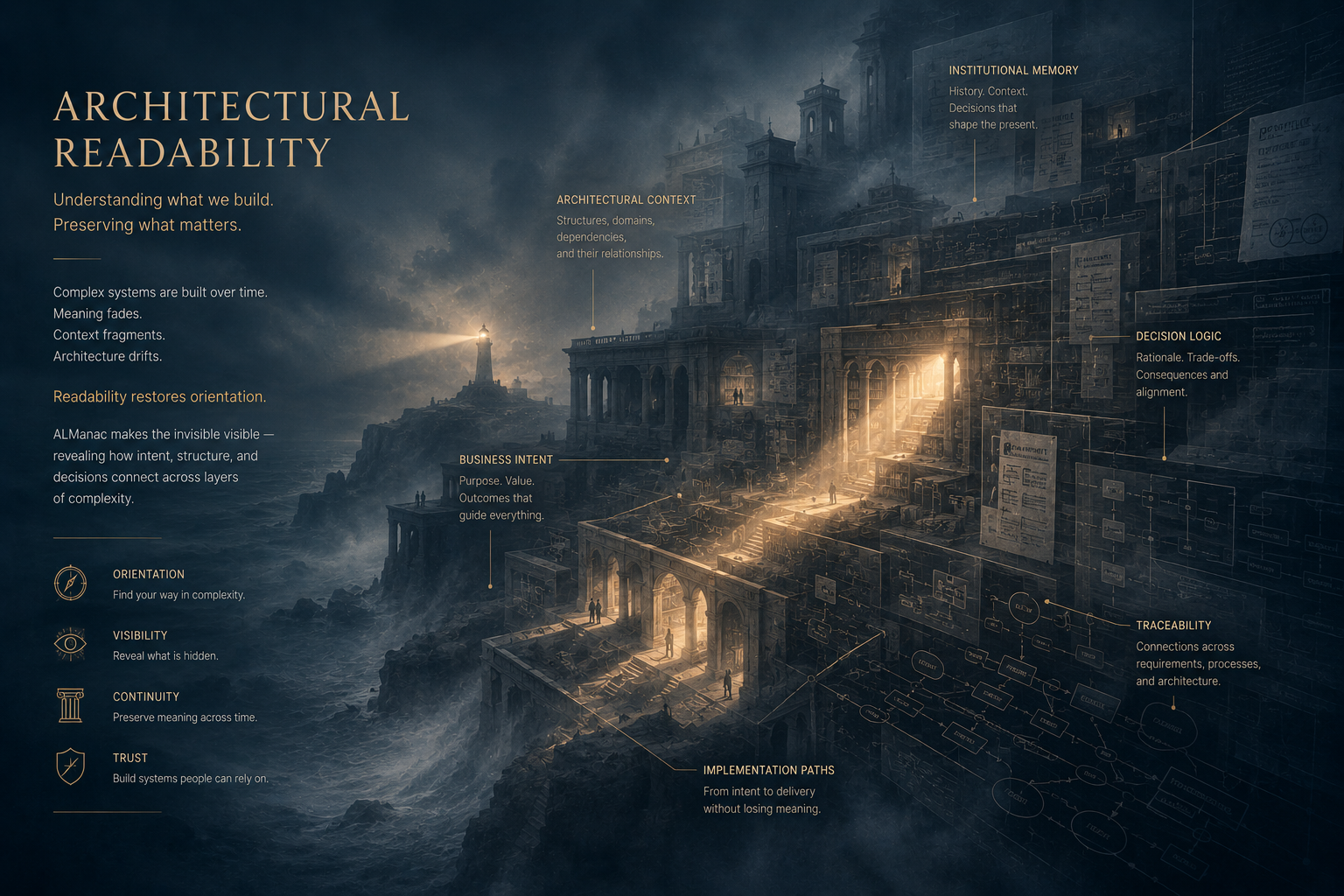
A lighthouse does not control the sea. It does not steer ships or issue commands. It makes the environment readable.
ALManac is a lighthouse for complex programs. It shows where intent has eroded, where coherence has broken down, and where delivery is about to amplify fragmentation.
Part of LUX143
ALManac is one renderer inside the broader LUX143 research field. It applies the field's continuity and traceability concerns to governed product-method work.
For canonical meaning, use the ecosystem overview rather than this product renderer.
- LUX143Research field
Canonical field meaning lives in the ecosystem overview.
- Guiding AIMethodology / principle
Summarized here only as governed orientation, not as ALManac-owned theory.
- ALManacInstitutional continuity renderer
A governed product-method surface for traceability, continuity, and pre-delivery handoff.
- Enterprise ServicesApplied practice
Professional application of the method in enterprise governance contexts.