Getting Started
ALManac is a product-method renderer for making organizational thinking visible before delivery begins. Onboarding is not just about learning features; it is about learning how to read whether a complex program is still coherent.
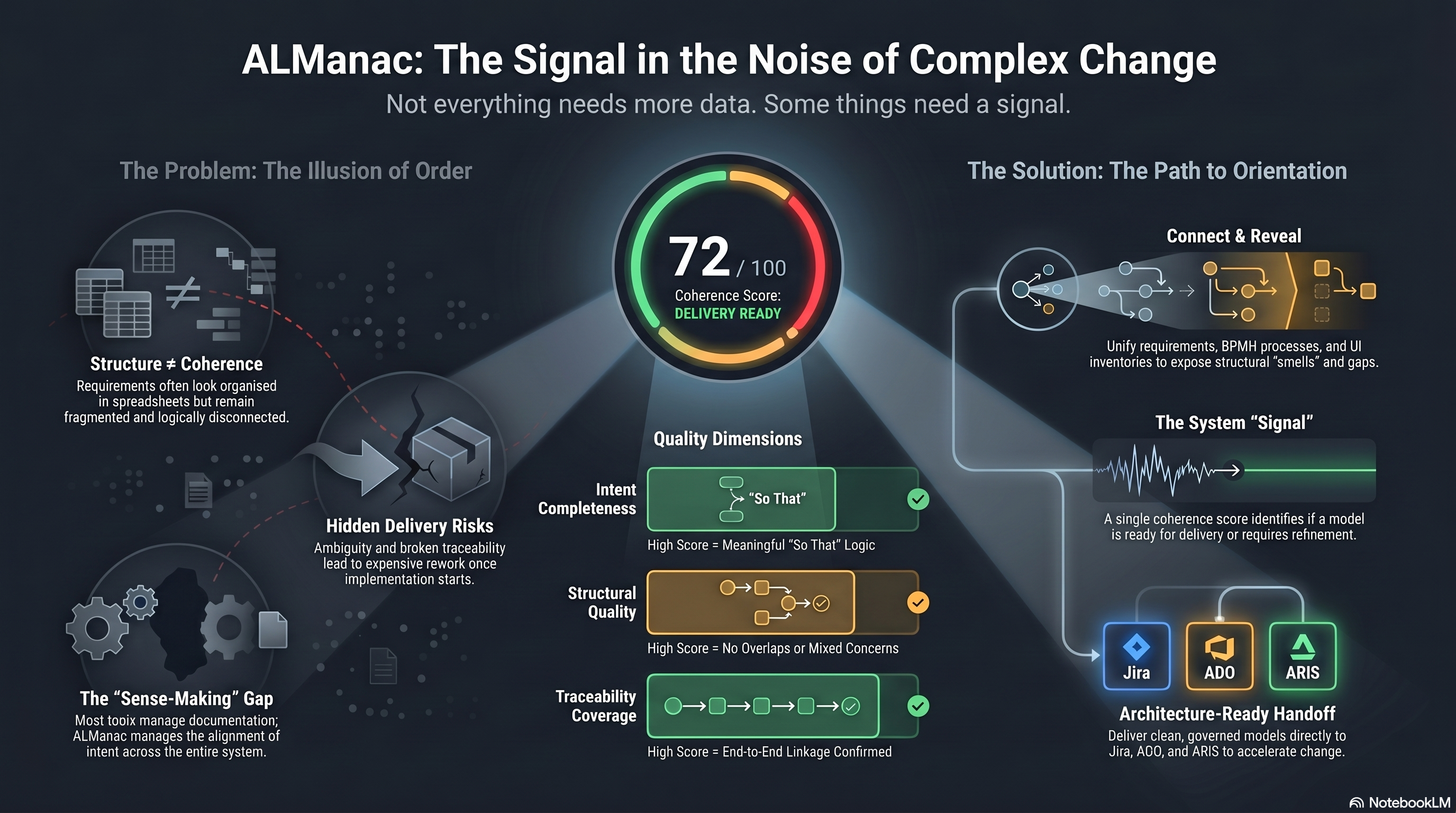
What ALManac actually does
ALManac helps organizations:
- structure requirements before delivery
- preserve business intent
- detect coherence drift
- govern AI-assisted proposals safely
- prepare architecture-ready handoff packages
It is a governance and coherence layer that helps organizations avoid building the wrong thing with perfect discipline.
For the canonical ecosystem meaning behind the renderer, use the LUX143 ecosystem overview.
A typical workflow
- Capture or import requirements.
- Connect glossary concepts, journeys, BPMN, UI, and data context.
- Detect weak traceability, intent degradation, and structural gaps.
- Review AI-generated proposals in governed draft flows.
- Analyze coherence, impact, and architectural readiness.
- Export architecture-ready handoff packages for downstream systems.
Proposal-only governance
ALManac never allows AI or automated analysis to silently rewrite canonical requirements.
AI-assisted outputs, refinement suggestions, self-coherence findings, and BPMN-generated drafts remain proposal-only until explicitly reviewed and accepted by a human.
Three concepts to understand first
Intent
Intent is the original reason a requirement, process, or design decision exists. If you cannot answer why something exists, you have found something worth fixing.
Coherence
A system is coherent when its parts are aligned: requirements connect to processes, processes connect to delivery, and everything traces back to the intent it serves.
Traceability
Traceability is the thread that connects intent to delivery. Without traceability, every change is a risk. With it, changes become navigable.
What good looks like
By the time an engagement is running well, the team should have confidence that what is being built reflects what was intended, visibility into fragile logic before it becomes expensive, a shared language across business and technical teams, and clean handoffs into downstream tools.